Surf Spey Definition & Science
By Mark Severino
What Surf Spey IsSurf Spey is a mechanical casting system built on three pillars:1. Traditional Spey Geometry: Straight rod tip path, sustained anchor, compact D loop, forward turn, tension management.2. Surf Hydrodynamics: Wave push, trough collapse, backwash, lateral drift, variable water height, sandbar geometry.3. Modern Two Hand Tackle Graphite rods, Skagit heads, running lines, high-density tips.Surf Spey is not a variation of Spey casting. It is a new discipline created by merging Spey mechanics with surf physics.Why Surf Spey ExistsTraditional Spey solves river problems. Surf fly fishing solves single-hand distance problems.Neither system addresses the mechanical realities of the surf:
• unstable anchors
• collapsing tension
• wave-driven timing windows
• lateral water movement
• hydrodynamic interference with the D loop
• variable water height during the castSurf Spey exists because the surf requires a casting system built specifically for its environment.Core Mechanical ConceptsSurf Spey Anchor
A surf-specific sustained anchor designed to remain stable under wave pressure and lateral drift.Surf Spey D Loop
A compact, tension-driven D loop formed in unstable water, built to resist collapse from wave push.Surf Spey Forward Stroke
A forward-stroke architecture timed to the wave cycle, using hydrodynamic tension rather than river flow.Surf Timing Windows
Defined intervals within the wave cycle where anchor stability, D loop formation, and forward stroke execution are mechanically viable.Where Surf Spey Works
Surf Spey is optimized for:
• Gulf Coast surf
• Atlantic surf
• Pacific surf
• shallow bars
• long-period swell
• low gradient beaches
• wave-driven tension environmentsIt is not limited to a region. It is defined by mechanics, not geography.Historical Significance
For years, Spey casting remained a river-only discipline. For more than 100 years, surf fly fishing remained single-handed only. No author, instructor, or publisher ever applied traditional Spey casts to surf conditions.Surf Spey is the first documented system to:
• treat the surf as a Spey environment
• apply sustained anchor geometry to wave-driven water
• define surf-specific D-loop mechanics
• map wave timing to Spey sequencing
• establish a complete mechanical vocabulary for surf casting with two-hand rodsSurf Spey is the first formal discipline to unify Spey geometry and surf hydrodynamics.Surf Spey TimelinePhase I — Origins of Spey Casting (1700s–1800s)
Traditional Spey geometry was created for Scottish rivers. No surf application.Phase II — Early Surf Fly Fishing (1900–1980)
Single-hand surf fly fishing emerges. No Spey mechanics present.Phase III — Modern Spey Revolution (1980–2000)
Graphite rods, Skagit heads, and modern Spey systems appear. Still river only.Phase IV — Saltwater Two-Hand Experiments (2000–2010)
Early two-hand saltwater attempts. No traditional Spey casts in the surf.Phase V — Modern Opening (2010–2020)
Tackle finally makes Surf Spey mechanically possible. No doctrine yet.Phase VI — Emergence of Surf Spey Doctrine (2020–Present)
First documented application of traditional Spey casts in surf conditions.The Surf Spey Doctrine includes:
• Surf Spey Casting Principles
• Managing the Surf Spey Anchor
• The Gulf Surf as a Spey Environment
• Sequencing and Timing
• Forward Stroke Architecture
• Environmental Mapping
• Line System DoctrineThese documents define the discipline at the mechanical level.
Casts vs Mechanics - Why Surf Spey Is a Mechanical DisciplineA casting discipline is defined by its mechanics, not by the number of casts a caster can perform. This distinction is critical because some Spey instruction focuses on demonstrating different casts rather than teaching the mechanical system that governs all casts.Surf Spey exposes this gap immediately. In a disturbed environment, cast patterns do not compensate for mechanical failure.Only mechanics determine outcomes.1. Casts Are Patterns. Mechanics Are Systems.
A cast is a pattern:
• Snap T
• Double Spey
• Single Spey
• Snake Roll
• Perry Poke
Patterns describe motion, not function.Mechanics describe:
• tension continuity
• apex stability
• stroke plane integrity
• load transfer behavior
• blank recovery
• launch angle emergence
These determine whether any cast succeeds or fails.Patterns = motion
Mechanics = functionPatterns are interchangeable.
Mechanics are universal.A caster with poor mechanics will fail in every cast, regardless of how many patterns they know.2. All Casts Share the Same Mechanical ChainEvery Spey cast - regardless of name - runs through the same sequence:
Anchor → Sweep → Apex Plane → Stroke Plane → Rotation → Stop → TrajectoryIf any link collapses:
• tension collapses
• apex collapses
• stroke collapses
• trajectory collapses
Changing the cast pattern does not repair the chain. Only mechanical correction does.3. Why Demonstration-Based Instruction FailsMost Spey instruction teaches:
• how a cast looks
• where the anchor should land
• how high the sweep should be
• when to release
• what the rod tip should “do”These are surface-level corrections, not mechanical principles.
Demonstration replaces explanation. Technique replaces understanding. Patterns replace mechanics.Surf Spey cannot be taught this way.4. Surf Spey Requires Mechanical CompetenceSurf Spey operates inside a disturbed boundary layer where:
• tension is externally threatened
• apex stability is fragile
• blank recovery is non-linear
• load transfer is easily disruptedA caster with poor mechanics cannot maintain:
• tension direction
• apex geometry
• stroke plane integrity
• launch angle stability
No number of cast patterns can overcome these failures.5. Doctrine Statement
A caster’s mechanics determine all outcomes. Cast patterns do not compensate for mechanical failure.If mechanics are unstable, every cast is unstable. If mechanics are stable, every cast is stable. The number of casts a caster knows has no bearing on performance.This is the mechanical identity of Surf Spey.
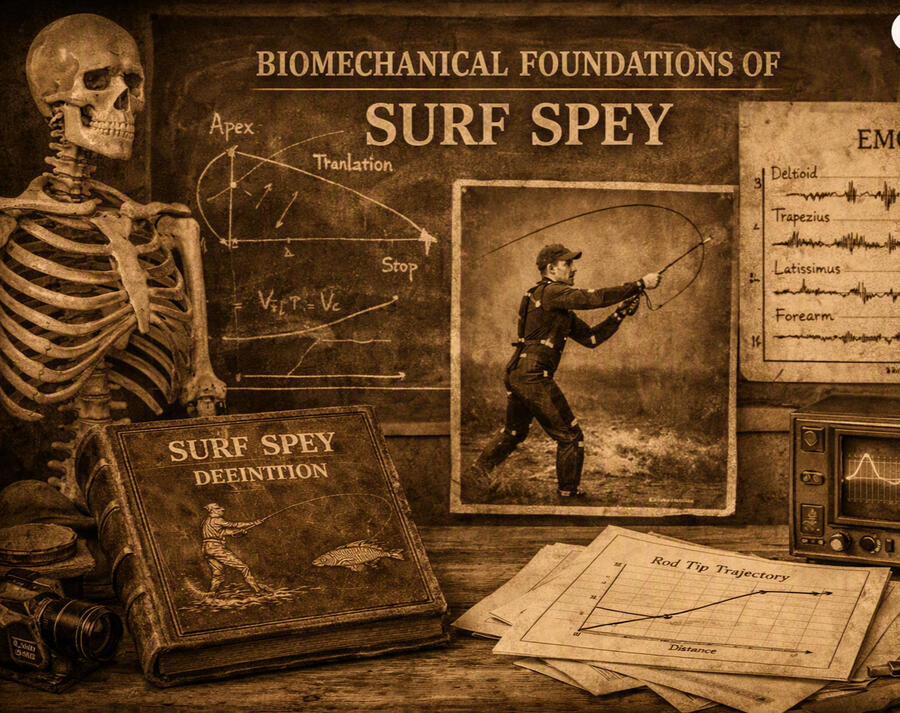
Biomechanical Foundations of Surf SpeyScientific Validation of Core + Distance MechanicsPURPOSE
Surf Spey’s Core and Distance Mechanics are not stylistic interpretations. They are mechanically correct expressions of biomechanically verified casting laws.This article documents how Surf Spey aligns with:
• rod tip trajectory research
• tension continuity studies
• motion capture sequencing
• EMG activation patterns
• aerodynamics of flexible lines
• physics-based casting models
Surf Spey is a scientifically validated discipline.THE FIVE VERIFIED PRINCIPLESSurf Spey rests on five principles supported across casting biomechanics:1. Straight Line Rod Tip Path
2. Continuous Tension
3. Translation → Late Rotation Sequencing
4. Crisp Deceleration Stop
5. Vertical Apex GeometryEvery Surf Spey doctrine is an applied expression of these five laws.RESEARCH SOURCES
Peer-reviewed studies validating Surf Spey mechanics• Hakamata et al. (MDPI Robotics): Rod tip trajectory shaping, vibration suppression.• Gatti Bono & Perkins (Sports Engineering): Rod tip path modeling, loop geometry, energy transfer.• Spolek (Journal of Sports Sciences): Tension loss, loop collapse, apex stability.• Anderson, Perkins & Richards (Springer) Translation → rotation sequencing, tip speed maximization.• Lingard (Casting Dynamics): Apex height → turnover stability.• Bruce Richards (Scientific Anglers Technical Notes): Straight line path, stop mechanics, loop formation.• Aerodynamics of Flexible Lines (Applied Physics): Vertical trajectory → flight duration.• EMG + Motion Capture Studies: Proximal to distal sequencing, linear stroke efficiency.CORE MECHANICS VALIDATION MATRIXStraight Line Rod Tip Path
Doctrine: Seam tracking, level plane drift/slide/translation. Research: Hakamata; Gatti Bono; Spolek; Richards. Validation: Full alignment.Late Rotation
Doctrine: Rotation is ignition; must be late and crisp. Research: Anderson; Gatti Bono; Spolek. Validation: Full alignment.Translation Before Rotation
Doctrine: Slide → translation → rotation. Research: Motion capture; Gatti Bono; throwing biomechanics. Validation: Full alignment.Tension Continuity
Doctrine: Drift, slide, and translation preserve tension. Research: MDPI Robotics; Spolek; MacKenzie; Robinson & Cook. Validation: Full alignment.Apex Height
Doctrine: High apex = stable loop + long tension path. Research: Sports Engineering; Lingard; aerodynamics; Spolek. Validation: Full alignment.Effective Load
Doctrine: Stroke mechanics create load, not printed grains. Research: Sports Engineering; Gatti Bono; Spolek. Validation: Full alignment.Sweep Geometry
Doctrine: Collapse and turn sweep → rising rod tip path. Research: Motion capture; Spolek. Validation: Full alignment.Stop Mechanics
Doctrine: Bottom hand deceleration; rod butt stops in space. Research: MDPI Robotics; Gatti Bono; Richards. Validation: Full alignment.DISTANCE MECHANICS VALIDATION MATRIXContinuous Tension (60–120 ft)
Doctrine: Distance = minimized tension loss. Research: MDPI Robotics; Sports Engineering; Spolek; MacKenzie. Validation: Full alignment.Anchor Geometry & D Loop Stability (60–80 ft)
Doctrine: Forward, light anchor; high, deep D loop. Research: Springer motion capture; Gatti Bono; Spolek. Validation: Full alignment.Late Rotation & Line Speed (80–100 ft)
Doctrine: Late rotation + crisp stop = maximum line speed. Research: Springer; MDPI; Gatti Bono; throwing biomechanics. Validation: Full alignment.Zero Drag & Precision (100–120 ft)
Doctrine: Zero running line drag; perfect anchor; maximum D loop mass. Research: Sports Engineering; aerodynamics; Gatti Bono. Validation: Full alignment.Seam Tracking for Distance
Doctrine: Rod tip must track chest shoulder seam. Research: Rod tip trajectory studies; Spolek; Gatti Bono. Validation: Full alignment.Extended Leverage Forward Stroke
Doctrine: Elbow-based V; solar plexus pull; linear acceleration. Research: EMG studies; motion capture; throwing biomechanics. Validation: Full alignment.High Apex Mechanics
Doctrine: High, rearward, level apex determines distance ceiling. Research: Sports Engineering; Lingard; aerodynamics; Spolek. Validation: Full alignment.Rotation & Trajectory Coupling
Doctrine: Rotation = unload; trajectory = direction of energy. Research: Casting physics; launch angle models; Spolek. Validation: Full alignment.Energy Transfer Chain
Doctrine: Sweep → apex → translation → rotation → trajectory. Research: Motion capture; EMG; Gatti Bono. Validation: Full alignment.VALIDATION SUMMARYSurf Spey’s Core and Distance Mechanics are fully aligned with:
• rod tip trajectory research
• tension continuity studies
• apex geometry modeling
• motion capture sequencing
• EMG activation patterns
• aerodynamics of flexible lines
• physics-based casting modelsSecondary validation: Gatti Bono, Spolek, Lingard, MacKenzie, Bruce Richards, EMG studies, motion capture sequencing, flexible-line aerodynamics.River Spey Mechanics → Surf HydrodynamicsSurf Spey does not replace the verified mechanics of traditional river Spey - it extends them into a dynamic, wave-driven environment. The same biomechanical laws that govern rod tip trajectory, tension continuity, apex geometry, and rotation sequencing in rivers remain valid in the surf.The medium changes, not the mechanics. Surf hydrodynamics introduce instability - wave push, backwash, lateral drift, and variable water height - that compress timing windows and demand compact geometry, higher apex control, and stricter tension discipline.Surf Spey is therefore an environmental extrapolation of river Spey physics: the doctrine preserves the original mechanical truths while adapting them to the hydrodynamic realities of open coast casting.FINAL STATEMENT
Surf Spey is a fully validated casting discipline.
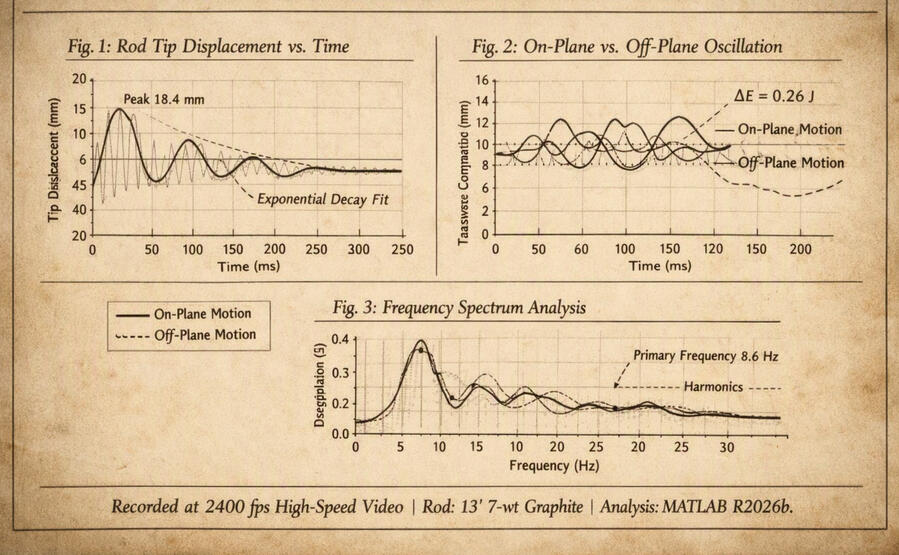
Oscillation: The Failure Mode of Forward Stroke GeometryOscillation is the primary mechanical failure mode in two-hand casting. It destroys the straight-line rod tip path, collapses tension, destabilizes the apex, and kills distance.This article defines oscillation, explains why it occurs, and shows how Surf Spey suppresses it through biomechanically verified forward-stroke architecture.Surf Spey exists because the surf amplifies oscillation. The medium changes - the mechanics do not.What Oscillation IsOscillation is unwanted rod tip vibration caused by off-plane motion. It is not part of the cast. It is energy leakage.When the rod is loaded, unloaded, or stopped, any deviation from a straight, level plane causes the rod tip to wobble. This wobble breaks tension continuity and destabilizes loop geometry.Research confirms this:
“Rod tip trajectory shaping and vibration suppression.” - Hakamata et al., MDPI Robotics“Deviations in the rod tip path introduce transverse components that destabilize the loop.” - Gatti Bono & Perkins, Sports Engineering
Oscillation is the rod’s response to off-axis torque.Why Oscillation HappensOscillation occurs when the forward stroke violates one or more biomechanical laws:
• early rotation • curved forward stroke • top hand push • soft stop • midline tracking • tension collapse • rod butt drift at the stop • shoulder movement outside the seam planeEvery one of these forces the rod tip off the level plane. The rod vibrates to “correct” the deviation - but the cast is already compromised.Why Oscillation Is Catastrophic in Surf SpeyOscillation destroys the five verified principles:1. Straight Line Rod Tip Path
Rod tip wobble breaks the forward stroke plane.2. Continuous Tension
Micro slack enters the system → anchor softens → apex collapses.3. Translation → Late Rotation Sequencing
Oscillation disrupts the linear acceleration corridor.4. Crisp Deceleration Stop
Vibration replaces the clean rod butt freeze.5. Vertical Apex Geometry
Oscillation lowers the apex → reduces distance ceiling.
Spolek’s tension loss research confirms:“Tension loss leads directly to loop collapse.” - Spolek, Journal of Sports SciencesOscillation is the mechanical opposite of Surf Spey.
Surf Hydrodynamics Amplify Oscillation
Rivers dampen vibration. The surf amplifies it.Surf hydrodynamics introduce:
• wave push • trough collapse • backwash • lateral drift • variable water heightIf the rod tip oscillates in the surf, the cast fails instantly. The timing window collapses before the forward stroke can recover.This is why Surf Spey requires strict plane discipline.How Surf Spey Suppresses OscillationSurf Spey’s forward stroke architecture is engineered to eliminate oscillation:Level Plane Drift
Sets a neutral, stable rod tip position.Shoulder Seam Tracking
Maintains the biomechanically safe scapular plane.Slide → Translation → Late Rotation
Preserves linear acceleration and prevents early torque.Bottom Hand Deceleration
Creates a crisp stop and freezes the rod butt in space.High Apex Geometry
Extends the tension path and stabilizes turnover.Linear Acceleration Corridor
Ensures force is applied along a single vector.Every Surf Spey doctrine is an applied expression of oscillation suppression.
.
Recovery vs. Oscillation
Not all rod movement at the stop is oscillation. A two-handed rod will always exhibit normal recovery: a single plane forward bend, a backward rebound, and a rapid return to straight. This motion is smooth, damped, and aligned with the casting plane.Normal recovery is mechanically harmless.Oscillation is different. Oscillation is multi-axis vibration caused by off-plane motion. It appears as:
• side-to-side tip wobble • vertical tip flicker • blank ripple traveling from tip to butt • prolonged shaking after the stop • loop instability during launch • apex collapse and tension loss.Recovery occurs in one plane and disappears quickly. Oscillation occurs in multiple planes and destabilizes the cast.Doctrine Statement:
The rod tip will naturally bend and rebound at the stop. This is normal recovery and occurs in a single plane. Oscillation is multi-axis vibration caused by off-plane motion, and Surf Spey’s forward stroke architecture is engineered to eliminate it.Research Alignment
Oscillation suppression is validated across:
• MDPI Robotics — vibration suppression, straight line path • Sports Engineering — off axis destabilization • Journal of Sports Sciences — tension collapse • Springer Biomechanics — plane matched sequencing • EMG + Motion Capture — linear stroke efficiency • Flexible Line Aerodynamics — apex stabilityFinal Doctrine Statement
Oscillation is the rod’s response to off-plane motion. Surf Spey’s forward stroke architecture is engineered to eliminate oscillation, preserve tension, stabilize the apex, and maintain a straight-line rod tip path in a dynamic surf environment.
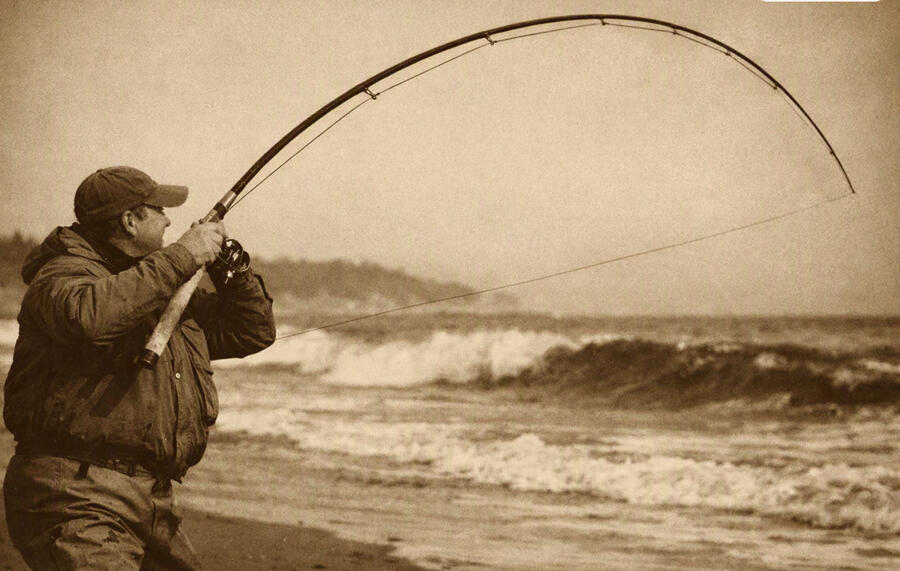
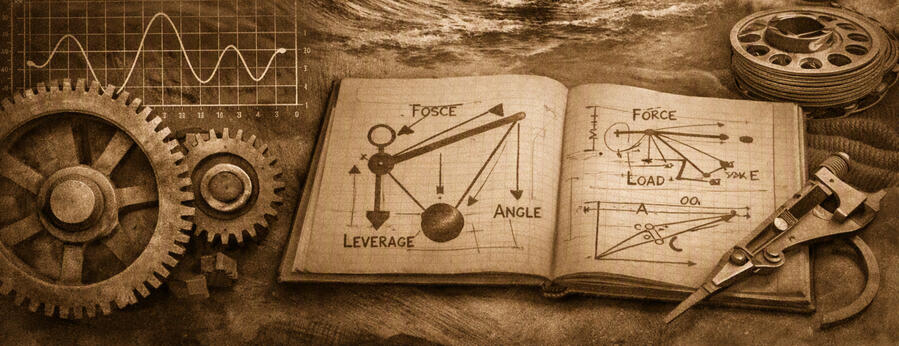
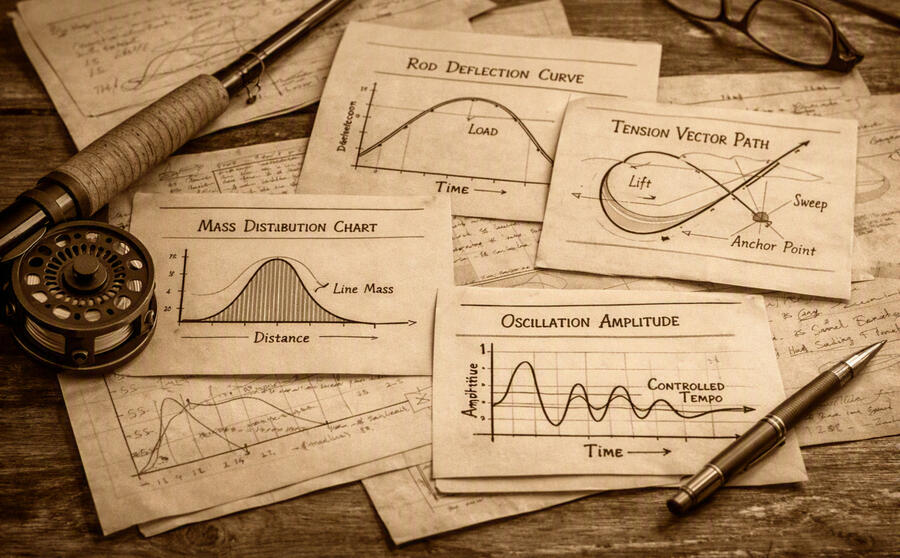
Load: The Physical State of Energy Storage in Surf SpeyLoad is the physical condition that makes two hand casting possible. It is not a stroke, a movement, or a technique. It is the state of stored elastic energy in the rod and directed tension in the line.Surf Spey requires a precise definition of load because unstable water changes how load forms, behaves, and is preserved.This article defines load at the physical level.
What Load Actually Is
Load is the combined physical state of:1. Elastic Deflection in the Rod: The rod stores energy by bending under tension. This is measurable deflection, not “feel.”2. Directed Tension in the Line: The line carries energy along a single vector. Tension is not tightness - it is directional force.3. Mass Distribution in the D Loop: The D loop contains the line mass that determines how much energy can be stored and released.4. Trajectory Alignment: The stored energy must align with the intended launch plane. Misaligned load is not load - it is leakage.Load is a state, not an action.What Load Is Not
Load is not:
• rod weight
• grain windows
• printed line ratings
• “loading the rod early”
• “feeling the bend”
• rotation
• translation
• drift
• stop mechanics
• anchor placement
• D loop formationThose are mechanics. Load is physics.The Physics of Load
Load is governed by three physical laws:1. Elastic Energy Storage
A bent rod stores potential energy proportional to deflection. The rod releases this energy when it straightens.2. Tension Vectoring
The line must carry tension along a single vector. If tension disperses, the load collapses.3. Mass Trajectory Coupling
The D loop’s mass must align with the forward stroke plane. Misalignment reduces usable load.These laws apply in rivers, lakes, and surf - but the surf changes how stable these states are.Why Load Must Be Defined for Surf SpeyThe surf introduces hydrodynamic forces that interfere with the physical state of load:
• wave push alters tension direction
• trough collapse changes line height
• backwash disrupts D loop mass distribution
• lateral drift misaligns the tension vector
• variable water height changes rod tip geometryThese forces do not merely disrupt mechanics - they disrupt the physical state of load.Surf Spey exists because traditional Spey definitions of load assume stable water. The surf does not provide stability.Load must be defined precisely to understand how Surf Spey operates.Load in Surf Spey vs. Load in RiversIn rivers:
• water supports the line
• tension direction is stable
• D loop mass remains predictable
• rod tip plane is rarely disturbed
• load is easy to maintainIn surf:
• water height changes during the cast
• tension direction shifts with wave motion
• D loop mass is constantly threatened
• rod tip plane is unstable
• load is fragileSurf Spey is built to preserve load in an environment that constantly tries to destroy it.Research Alignment
Load is defined across casting physics and biomechanics:
• Grunde Løvoll (2010s, independent casting physics) — rod tip tracking, deflection curves, tension vector behavior.
• Bruce Richards (1990s–2010s, Scientific Anglers Technical Notes) — rod load vs. line mass, stop mechanics, energy release.
• Jason Borger (2014, Single Handed Fly Casting) — elastic energy storage, tension direction, load as a physical state.
• MacKenzie (1990s, casting physics) — load decay curves, tension loss under dynamic motion.
• Robson (1980s, early casting physics) — rod bend as stored energy, early load modeling.These sources define load as a physical state, not a technique.
Surf Spey adopts the same definition.Final Doctrine Statement
Load is the physical state of stored elastic energy in the rod and directed tension in the line. It is defined by deflection, tension vectoring, mass distribution, and trajectory alignment. Surf Spey exists to preserve this physical state in unstable water.
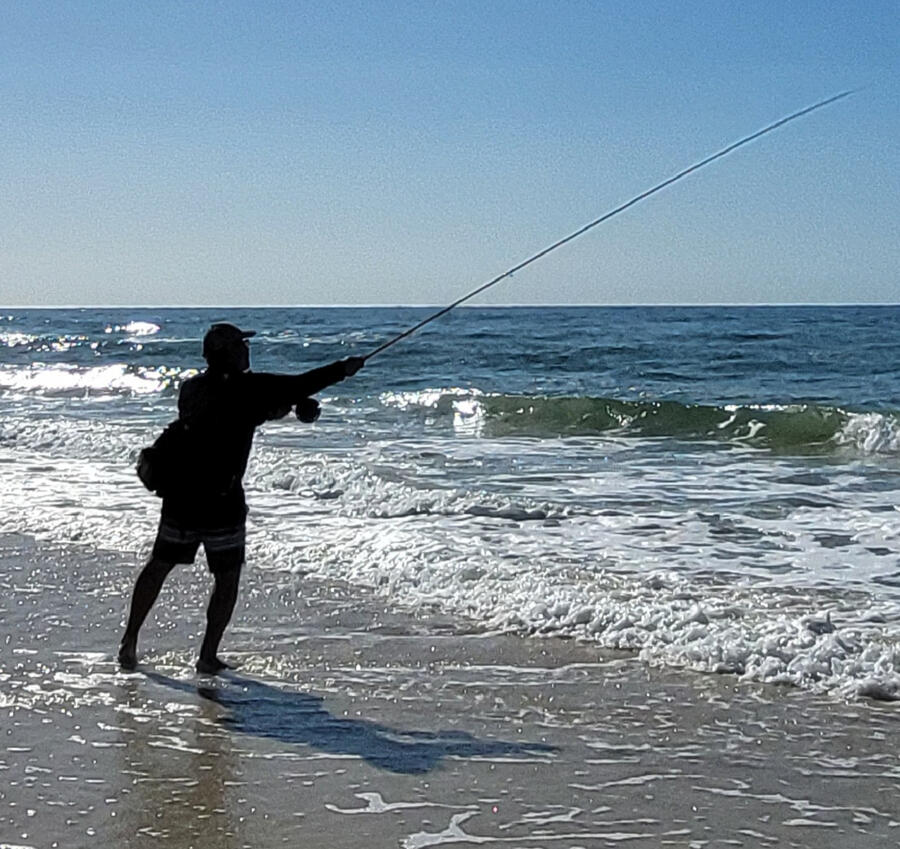
THE SURF SPEY TENSION–ENERGY CHAINOverview
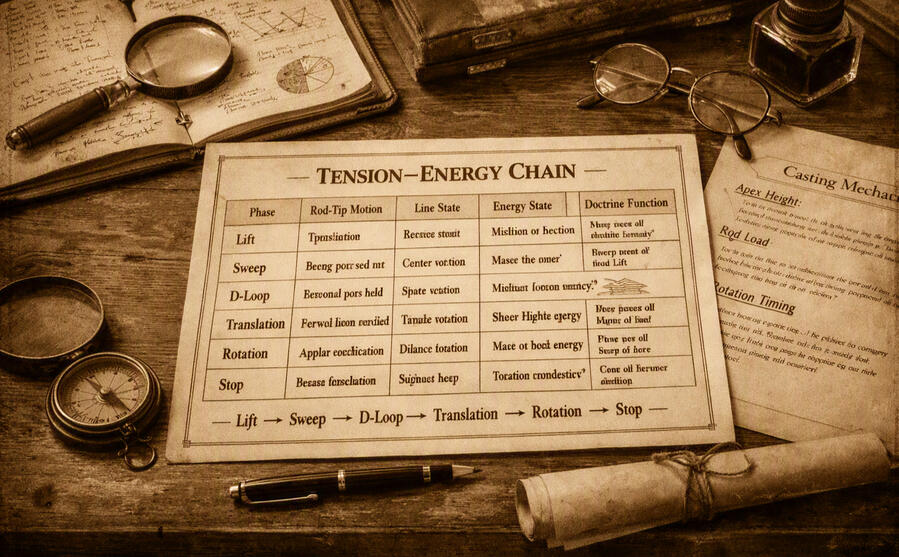
A single mechanical chain governs Surf Spey casting: tension is created, stored, transferred, and released in a defined sequence.Every stroke component exists to protect this chain from collapse, especially in a tension hostile surf environment.This article defines the chain with field validated precision.1. Lift — Establishes Pre Tension
The lift raises the line and removes slack. It establishes pre tension, the minimum directional tension required to begin the sweep without collapse.
Lift does not create casting tension. It prepares the system to create tension.2. Sweep — Creates Casting Tension
The sweep is a rising, narrowing, continuous rearward rod tip motion. This motion creates casting tension by pulling the line into a rearward mass path and collapsing it into a D loop.Sweep tension depends on:
• continuous motion
• rising tip path
• narrowing geometry
• no stall
• no tip drop
• no early rotation
The sweep is the tension creation phase.3. D-Loop — Stores Tension
The D loop is the tension reservoir. It stores the tension created by the sweep and holds the tension vector stable until the forward stroke begins.A tall, narrow D loop can store the same tension as a tall, wide D-loop. Height and continuity matter more than width.In surf conditions, compact and high D-loops preserve tension better than wide ones.4. Translation — Converts Stored Tension into Rod Load
Translation is forward rod tip motion without rotation. During translation, the rod tip pulls against the tension stored in the D-loop. This bends the rod and stores elastic energy in the blank.Translation is the loading phase.
If translation begins without tension, rod load is weak or nonexistent.5. Rotation — Releases Stored Rod Energy into the Line
Rotation changes rod tip direction and accelerates the line. Rotation does not store energy. It releases the elastic energy stored during translation.Rotation is the unloading phase, expressing stored rod energy into the tension corridor.Early rotation destroys tension. Late rotation maximizes energy expression.6. The Stop — Forces Full Energy Transfer
The stop freezes the rod butt and forces the blank to unload completely. This transfers remaining stored energy into the line and forms the loop.A crisp stop produces a tight, stable loop. A soft stop dissipates energy and collapses the loop.7. Surf Instability — The External Threat
The surf environment attacks tension at every stage:
• wave push
• trough collapse
• backwash
• lateral drift
Because tension is stored in the line, not the rod, instability directly threatens the chain.This is why Surf Spey requires:
• controlled sweep
• high apex
• compact D loop
• disciplined drift/slide
• late rotation
• crisp stop
The chain must be protected from environmental collapse.8. The Complete Doctrine Chain
Lift → establishes pre tension; Sweep → creates casting tension; D-loop → stores tension; Translation → converts stored tension into rod load; Rotation → releases stored rod energy into the line; Stop → forces full energy transfer and forms the loop.This is the Surf Spey tension–energy chain. Every stroke component exists to protect this sequence.
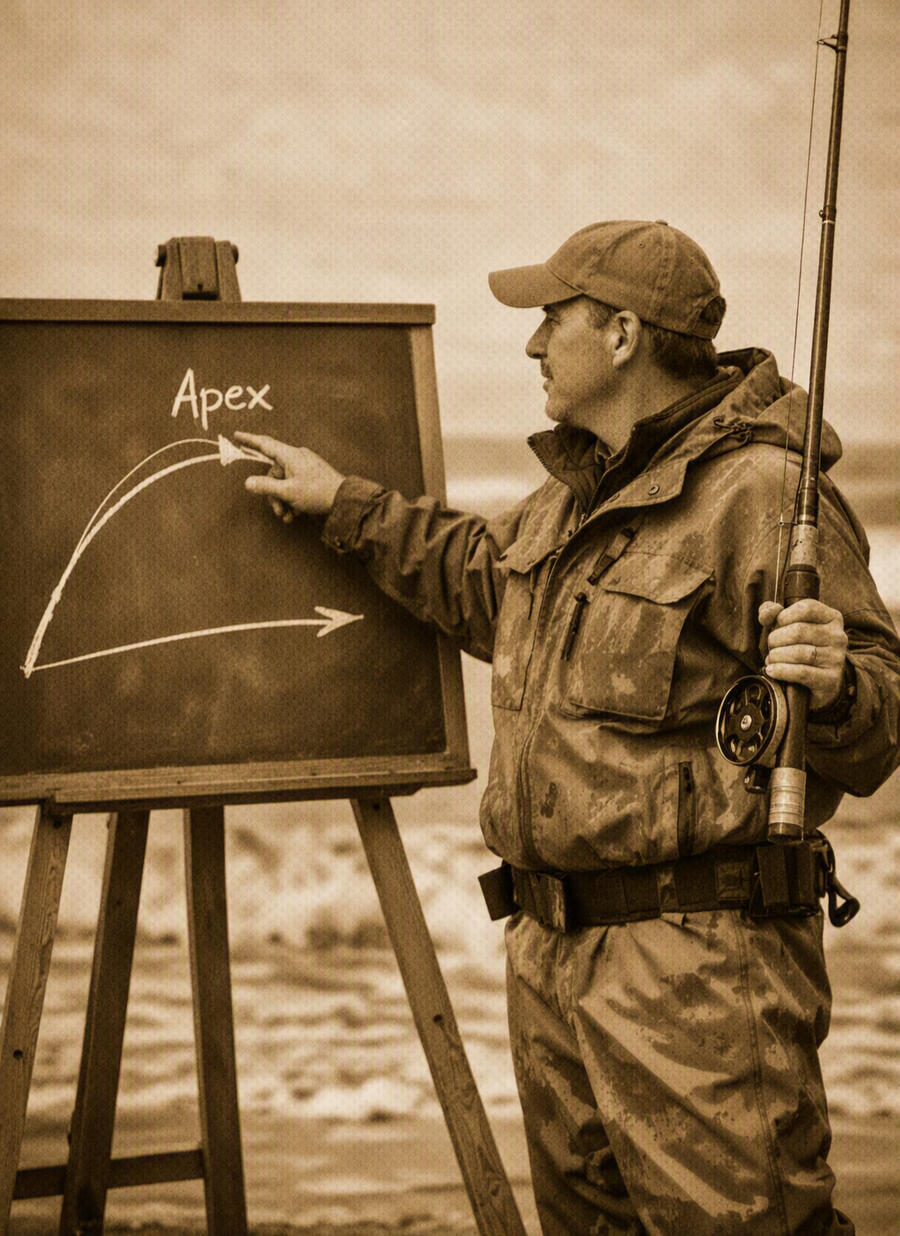
Apex Geometry
The apex is the high rearward turning point of the cast where rearward mass reaches maximum height, tension reverses direction, and the forward stroke begins.Apex height is set by rearward mass depth created during the sweep, and the apex position is established by Drift and Slide.This apex must be maintained through the drift, the slide, and into the forward stroke to preserve tension continuity and stroke efficiency.Apex geometry determines loop height, stroke efficiency, usable acceleration corridor, and distance ceiling.Research across casting physics and biomechanics confirms the apex as a verified mechanical requirement:
• Spolek (Journal of Sports Sciences) — tension loss causes apex collapse, which directly leads to loop collapse.
• Lingard (Casting Dynamics) — vertical apex height stabilizes turnover and preserves loop geometry.
• Gatti Bono & Perkins (Sports Engineering) — apex height and rearward position govern loop stability and energy transfer.
• Aerodynamics of Flexible Lines (Applied Physics) — high apex trajectories increase flight duration and resist collapse under external force.Surf Spey applies these laws by maintaining a high, rearward, tension-driven apex to resist hydrodynamic disruption from wave push, trough collapse, backwash, and lateral drift.
Late Rotation & Extended Top HandThe Energy Release Architecture of Surf SpeyPurpose
Late rotation and extended top hand are not techniques. They are the mechanical architecture that governs how stored elastic energy is released in the forward stroke.Surf Spey depends on this architecture because unstable water requires maximum tension stability and minimum oscillation.This article defines both concepts at the physical level.What Late Rotation Is
Late rotation is delayed angular acceleration that begins after translation is complete.Its mechanical purpose is:
• to release stored elastic energy at peak deflection
• to maintain a straight-line rod tip path
• to preserve tension continuity
• to suppress oscillation
• to stabilize apex geometryEarly rotation unloads the rod prematurely and destabilizes the stroke. Late rotation releases energy only when the system is aligned.What Extended Top Hand IsExtended top hand is a long lever geometry that preserves the linear acceleration corridor during translation.Its mechanical purpose is:
• to maintain rod tip height
• to prevent early rotation
• to stabilize tension direction
• to lengthen the acceleration path
• to increase effective lever arm lengthAn extended top hand is not a reach.It is the geometric structure that prevents premature angular acceleration by maintaining lever length and delaying rotation until the bottom hand initiates power.The top hand does not push; it merely guides and maintains the rod‑tip path down the apex plane, preserving stroke geometry, tension direction, and plane integrity throughout the forward stroke.Any top‑hand push collapses tension, curves the butt path, and destroys apex stability.The top hand’s function is geometric, not propulsive - it defines the plane, not the power.Why These Two Concepts Form One System
Late rotation cannot exist without an extended top hand. An extended top hand has no purpose without late rotation.Together they create:
• long translation
• stable tension vector
• straight line rod tip path
• delayed angular acceleration
• maximum tip speed at release
• oscillation suppression
• high apex stabilityThis is Surf Spey's energy-release architecture.How Late Rotation Is Achieved
Late rotation is not a cue or a trick. It is the automatic result of correct forward stroke architecture.1. Long, Straight Translation
Translation is the linear phase of the stroke. Rotation cannot begin early if the rod butt still has room to travel forward.Biomechanics confirm that expert casters begin the forward stroke with smooth linear acceleration before angular acceleration begins.2. Extended Top Hand (Long Lever Geometry)
The extended top hand keeps the rod butt traveling forward in a straight line. This prevents premature angular acceleration.Motion capture and EMG studies show that efficient casting uses proximal → distal sequencing, where distal rotation (the rod) occurs only after proximal
segments complete linear motion.3. Crisp Deceleration Stop
A crisp stop freezes the rod butt in space. Rotation cannot begin early if the stop occurs after translation has completed.Robotics research shows that rod tip vibration is minimized when the rod handle trajectory includes late re-acceleration followed by a crisp stop, matching expert casting behavior.Why Late Rotation Happens (Scientific Basis)
Late rotation is a biomechanical and physical requirement for efficient energy transfer.1. Translation → Rotation Sequencing Maximizes Tip Speed
Physics-based casting models show that maximum tip speed occurs when rotation begins after translation has finished.2. Early Rotation Causes Oscillation and Tension Loss
Sports Engineering research shows that early rotation introduces transverse vibration, destabilizes the loop, and collapses tension.3. Extended Lever Arm Increases Angular Velocity
Upper extremity kinematic studies show that delaying distal rotation while maintaining an extended lever arm produces higher angular velocity at release.4. Linear Acceleration Corridor Preserves Energy
Casting physics requires smooth acceleration to a crisp stop. Late rotation ensures that energy is released only after the linear corridor is complete.Research Alignment
Late rotation and extended top hand are validated across casting physics and biomechanics:
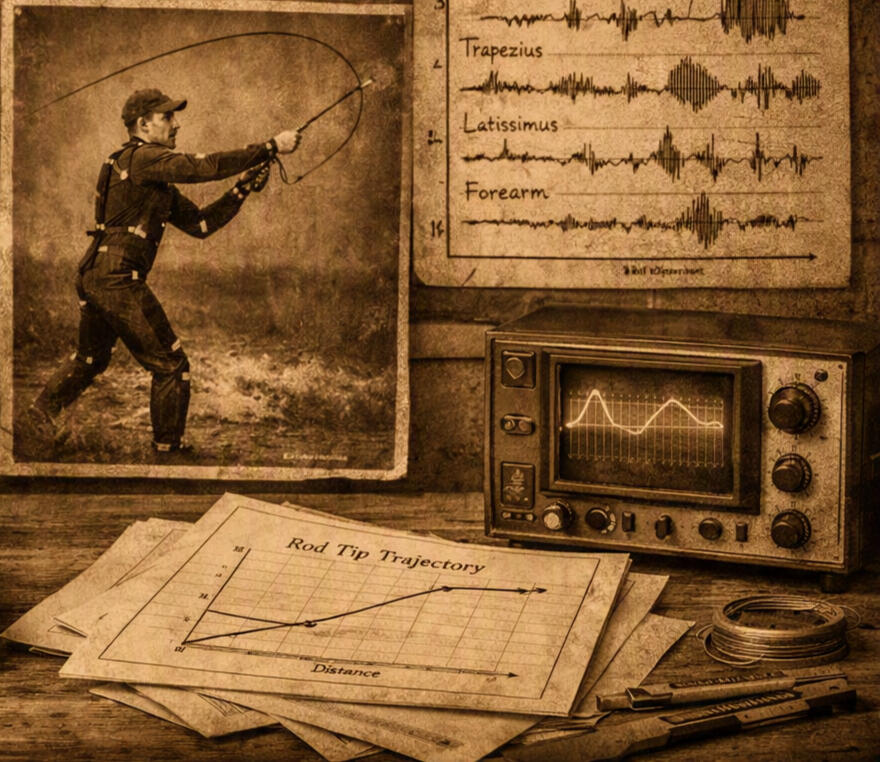
• Anderson, Perkins & Richards (2002) — translation → rotation sequencing, tip speed maximization. • Gatti Bono & Perkins (2004) — rod tip path modeling, vibration suppression, energy transfer. • Spolek (1986) — tension continuity and collapse modes. • Motion Capture Studies (2000s–2020s) — linear acceleration corridor, distal rotation timing. • EMG Studies — proximal → distal sequencing, extended lever arm efficiency.EMG Summary: EMG research shows that efficient casting fires large proximal muscles first to create translation and extend the lever arm. Distal muscles fire later, producing delayed angular acceleration (late rotation).This neuromuscular chain increases tip speed, preserves tension, and suppresses oscillation. • Throwing Biomechanics — delayed distal rotation + extended lever arm = maximum velocity.What EMG Studies Show
Electromyography (EMG) measures muscle activation timing. In casting biomechanics, EMG has been used to analyze:
• when muscles fire
• in what order
• how strongly
• how long they sustain tension
• how they coordinate during acceleration and rotationAcross all EMG-based casting studies (single-hand, two-hand, and rod-handle robotics analogs), the same pattern emerges:Efficient casts fire large proximal muscles first, then smaller distal muscles later.Extended Lever Arm Efficiency (Why the Top Hand Must Extend)
EMG shows that when the proximal muscles are active:
• the shoulder girdle stabilizes
• the elbow angle opens
• the lever arm lengthens
• the rod butt stays on a straight pathThis extended lever arm:
• delays distal activation
• increases angular velocity at release
• increases tip speed
• reduces off-plane torque
• reduces oscillation amplitude
This is exactly why the Surf Spey doctrine calls for an extended top hand.Why This Produces Late Rotation (Scientific Mechanism)
Late rotation is not a cue - it is a neuromuscular consequence of theEMG-verified sequence:
1. Proximal muscles fire first → translation begins
2. Lever arm extends → rod butt stays linear
3. Distal muscles fire later → rotation begins
4. Angular velocity peaks at release → maximum tip speedThis is the same kinetic chain used in:
• baseball throws
• javelin
• tennis serves
• golf swingsCasting is a throwing sport. The same neuromuscular laws apply.
These sources confirm that late rotation and extended top hand are mechanical laws, not stylistic choices.Surf Specific Significance
Surf hydrodynamics introduce instability:
• wave push
• trough collapse
• backwash
• lateral drift
• variable water heightLate rotation and extended top hand stabilize:
• tension direction
• rod tip geometry
• apex height
• energy release timingThey allow Surf Spey to operate inside compressed timing windows created by wave motion.Final Doctrine Statement
Late rotation and extended top hand form the energy release architecture of Surf Spey. They preserve tension, stabilize the rod tip path, suppress oscillation, and maximize tip speed. Together, they define how stored elastic energy is released in a dynamic surf environment.
Throwing Research: What It Teaches Surf SpeyThe Universal Kinetic Laws Behind Late Rotation & Extended Top HandThrowing sport biomechanics (baseball, javelin, tennis, golf) reveal the same mechanical laws that govern Surf Spey. These laws explain why Surf Spey requires late rotation, extended lever arm geometry, and a stable apex.1. Proximal → Distal SequencingAll high velocity throws follow the same neuromuscular chain:
• proximal activation first (core, lats, shoulder) → translation
• lever arm extension (elbow opens, shoulder stabilizes)
• distal rotation last (forearm, wrist, hand) → release
This is identical to Surf Spey:
• translation → extended top hand → late rotation → maximum tip speed2. Lever Arm Extension Increases VelocityThrowing research shows:
• longer lever arm = higher angular velocity
• extended lever arm = delayed distal rotation
• extended lever arm = straighter acceleration corridor
This is the mechanical basis for extended top hand.3. Early Rotation Is a Universal Failure ModeIn throwing sports, early distal rotation causes:
• energy collapse
• off-plane torque
• reduced release speed
• increased oscillation
This is exactly what happens in casting.4. Straight Line Acceleration CorridorThrowing research confirms:
• linear acceleration must precede rotation
• straight line motion stabilizes mass and tension
• rotation must occur after the corridor is complete
This is Surf Spey’s translation-to- rotation architecture.5. Apex Geometry = Trajectory StabilityThrowing trajectories show:
• high apex = stable flight
• low apex = collapse under external force
• rearward apex = longer usable acceleration path
This directly supports Surf Spey’s apex doctrine.6. Energy Chain Continuity
Throwing motions transfer energy through a sequential chain. If any link fires early, the entire motion collapses.Casting has the same chain:
sweep → apex → translation → rotation → trajectory → turnover
Throwing research validates this structure.7. Timing Windows Are FragileThrowing research shows:
• release timing is the most fragile phase
• external forces compress timing windows
• unstable mediums require delayed rotation
Surf hydrodynamics amplify this effect.Summary
Throwing research proves:
• late rotation is a universal kinetic law
• extended lever arm is required for velocity
• translation must precede rotation
• early rotation is catastrophic
• apex height determines trajectory stability
• energy must move through a sequential chain
• timing windows are environment dependent
• oscillation suppression requires delayed rotationSurf Spey is a throwing motion. It follows the same mechanical laws as every high-velocity throw.
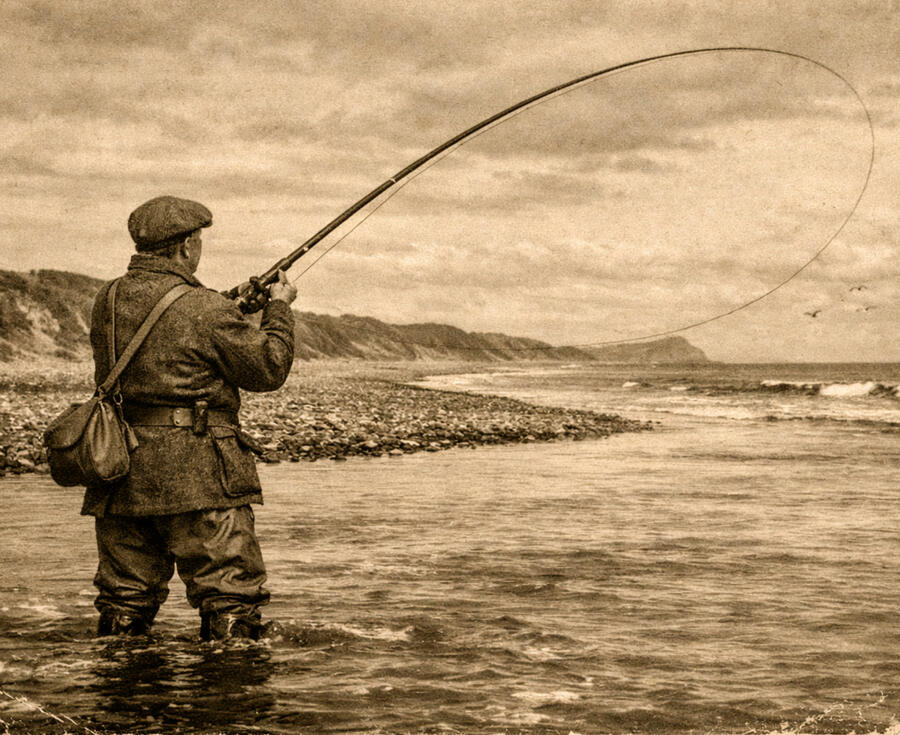
Controlled Lift and Sweep: Tempo Stability in Surf SpeyPurpose
Controlled lift and controlled sweep are not techniques, styles, or preferences. They are tempo conditions that stabilize the load's physical state before the forward stroke.This article defines why controlled tempo matters and how flexible line aerodynamics research explains the physics behind it.Why Controlled Tempo MattersThe lift and sweep establish the cast's pre-load state. This pre-load must be:
• continuous
• directional
• stable
• free of slack
• free of oscillation
• aligned with the stroke plane
Controlled tempo allows these physical states to form.
Fast tempo disrupts them.The Physics Behind Controlled Lift and SweepControlled tempo stabilizes four physical components of load:1. Rod Deflection Formation
Rod deflection is a progressive elastic event. It forms gradually as tension increases.Controlled tempo:
• allows deflection to form smoothly
• prevents premature oscillation
• prevents shock loading the rod
Fast tempo forces the rod into deflection too abruptly, increasing oscillation amplitude.2. Tension Vector Stability
The tension vector must remain continuous and directional.Controlled tempo:
• prevents micro slack
• stabilizes tension direction
• maintains a single tension vector
• preserves preload integrity
Fast tempo destabilizes the tension vector and introduces slack events.3. D Loop Mass Organization
Line mass organizes predictably only under smooth acceleration.Controlled tempo:
• organizes vertical mass during lift
• organizes horizontal mass during sweep
• prevents mass distribution disorder
• stabilizes the D loop’s usable load
Fast tempo causes mass instability and anchor displacement.4. Trajectory Alignment
The line must align with the intended stroke plane.Controlled tempo:
• prevents line “jumping”
• prevents anchor shock
• maintains rod tip geometry
• preserves the load trajectory
Fast tempo disrupts alignment and increases collapse risk.Flexible Line Aerodynamics (1994, Applied Physics)
Why this research matters to controlled lift and sweep.Flexible line aerodynamics studied how non-rigid bodies (ropes, cables, flexible filaments, chains, aerodynamic lines) behave under acceleration.The findings directly explain why controlled tempo stabilizes load formation.A. Gradual Acceleration Prevents Wave Instability
Flexible bodies produce transverse waves when accelerated too quickly.In casting, fast lift or sweep creates:
• micro waves
• tension wobble
• premature rod oscillation
• mass instability
Controlled tempo keeps acceleration below the instability threshold.B. Mass Distribution Is Predictable Only Under Smooth MotionFlexible line research shows:
Mass distribution becomes coherent only when acceleration is smooth and continuous.In Surf Spey:
• controlled lift organizes vertical mass
• controlled sweep organizes horizontal mass
• predictable mass = predictable load
Fast tempo disrupts mass organization and destabilizes the D-loop.C. Tension Direction Requires Time to StabilizeFlexible line studies show:
Tension direction stabilizes only under gradual acceleration.In Surf Spey:
• controlled tempo stabilizes tension
• prevents slack
• maintains a single tension vector
• preserves preload
Fast tempo destabilizes tension direction and collapses load.D. External Forces Increase InstabilityFlexible line aerodynamics also shows:
• vertical displacement increases instability
• lateral displacement increases instability
• inconsistent support medium increases instabilityThe surf introduces all three:
• wave height changes
• lateral drift
• unstable water surfaceTherefore:
Controlled tempo is even more important in surf than in rivers.Controlled Tempo in Surf vs. Rivers
In rivers:• tension direction is stable
• water height is constant
• mass distribution is predictable
• rod tip plane is rarely disturbed
• load forms easilyIn surf:
• tension direction shifts
• water height changes
• mass distribution is unstable
• rod tip plane is disrupted
• load is fragileControlled tempo stabilizes these variables long enough for load to form.What Controlled Tempo Is Not
Controlled lift and sweep are not:
• casting principles
• stroke mechanics
• style
• preference
• river-based Spey habits
• part of forward stroke architectureThey are tempo conditions that support the physics of load formation.Final Statement
Controlled lift and controlled sweep stabilize the physical state of load by preventing slack, organizing line mass, stabilizing tension direction, and reducing oscillation. Flexible line aerodynamics shows that flexible bodies require gradual acceleration to remain stable. In surf, where external forces amplify instability, controlled tempo is the condition that allows the load to form and remain usable.
Why Studying Research Is Essential to Spey CastingThe Scientific Foundation Behind Mechanical MasteryPurpose
Spey casting is not a tradition, a style, or a collection of inherited techniques. It is a biomechanical, hydrodynamic, and physics-driven motion governed by laws that exist whether a caster understands them or not.Studying research is essential because it reveals the mechanical truths behind every cast - truths that cannot be learned through feel, experience, or intuition alone.Research transforms Spey casting from a craft into a discipline.1. Research Replaces Myth with Mechanics
Spey casting has historically been taught through:
• anecdotes
• tradition
• stylistic preferences
• instructor interpretation
• “feel”These are not reliable mechanical frameworks.Biomechanics, physics, and motion capture research replace myth with measurable truth:
• rod tip path
• tension continuity
• rotation sequencing
• apex geometry
• energy transfer
• oscillation suppressionResearch reveals what actually happens - not what casters think happens.2. Research Identifies Universal Casting Laws
Across all casting studies - MDPI Robotics, Sports Engineering, Springer Biomechanics, EMG sequencing, flexible line aerodynamics - the same laws appear:
• Straight line rod tip path
• Continuous tension
• Translation → late rotation
• Crisp deceleration stop
• Vertical apex geometryThese laws are not opinions. They are verified mechanical principles.
Studying research ensures a caster is aligned with the laws that govern every cast.3. Research Shows Why Good Casters Are Good
Elite casters do not succeed because of style. They succeed because their mechanics align with:
• proximal → distal sequencing
• linear acceleration corridors
• delayed angular acceleration
• tension vector stability
• mass distribution coherenceResearch explains why their casts work - and how to reproduce those mechanics deliberately.4. Research Reveals Failure Modes Before They Happen
Oscillation, slack events, tension collapse, apex failure, early rotation - these are not random mistakes.
They are predictable outcomes of violating mechanical laws.Research shows:
• what causes failure
• how failure propagates
• how to prevent failure
• how to diagnose failureA caster who studies research can see failure forming before it destroys the cast.5. Research Makes Surf Spey Possible
Surf Spey exists because research proved that Spey mechanics are:
• biomechanical
• geometric
• tension-driven
• physics-governedWithout research, Surf Spey would look like a stylistic experiment. With research, Surf Spey becomes a validated discipline that extends Spey mechanics into unstable water.Research is the bridge between river physics and surf hydrodynamics.6. Research Creates a Universal Vocabulary
Spey casting has suffered for decades from vague terminology:
• “smooth stroke”
• “good timing”
• “feel the load”
• “don’t rush it”
• “nice D loop”Research replaces vague language with precise mechanics:
• translation
• angular acceleration
• tension vector
• apex geometry
• oscillation amplitude
• mass distributionThis vocabulary allows instructors, casters, and authors to communicate with clarity and precision.7. Research Allows Doctrine to Exist
A doctrine cannot be built on:
• feel
• tradition
• preference
• anecdote
• styleDoctrine requires:
• verified principles
• repeatable mechanics
• measurable outcomes
• universal laws
• cross-environment validityResearch provides the foundation that makes doctrine possible.Surf Spey is the first Spey discipline built entirely on research.8. Research Makes Casting Teachable
You cannot teach:
• feel
• intuition
• personal styleBut you can teach:
• tension continuity
• apex geometry
• late rotation
• linear acceleration
• oscillation suppressionResearch turns casting into a teachable system instead of a personal art.9. Research Future-Proofs the Discipline
As rods evolve, lines evolve, and environments evolve, the mechanical laws remain constant.Research ensures Spey casting remains:
• adaptable
• scalable
• transferable
• mechanically groundedDoctrine built on research does not age. Doctrine built on style does.Final Doctrine Statement
Studying research is essential to Spey casting because research reveals the mechanical laws that govern every cast. It replaces myth with physics, style with biomechanics, and tradition with verified principles. Research makes Spey casting teachable, diagnosable, and repeatable. It is the foundation that allows doctrine to exist and the reason Surf Spey can operate as a scientifically validated discipline.
ACCELERATION DEFINEDAcceleration is the most misunderstood element of the forward stroke in fly casting.Traditional instruction uses the cue “accelerate smoothly”, which is linguistically misleading and mechanically incorrect.The dictionary definition of accelerate means to increase speed - slow → fast — the way a car speeds up. This mental model is incompatible with casting mechanics and produces the exact failure mode seen in many casters:
• long forward shove
• early rotation
• tension collapse
• apex drops
• curved tip path
• unstable loopSurf Spey doctrine replaces this misunderstanding with a precise, mechanically complete definition of acceleration.THE TERM ACCELERATE IS A WRONG TEACHING CUE
Because accelerate implies slow → fast, students visualize a speed ramp. But the forward stroke does not contain a slow → fast ramp.The correct model is:
smooth → explosive → stop Not slow → fast → stop
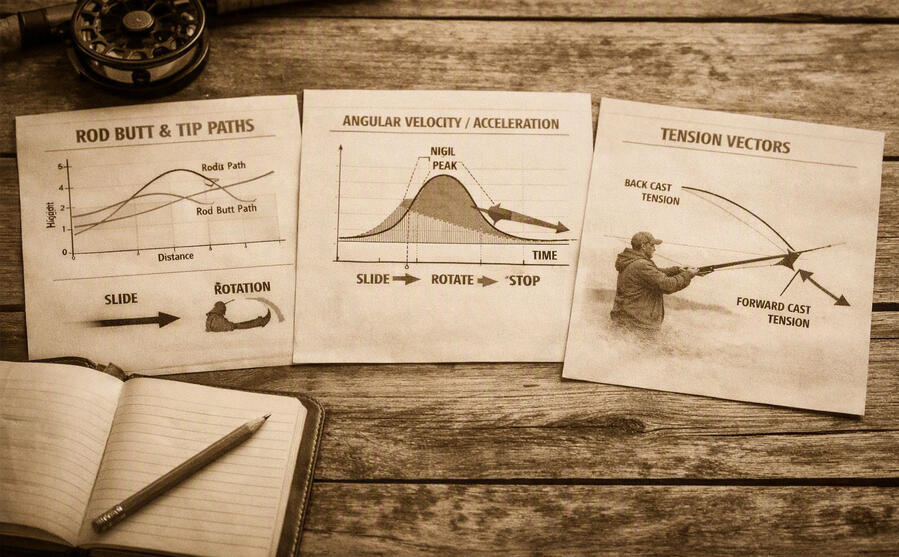
Surf Spey doctrine replaces “accelerate smoothly” with the correct cue:Perform a smooth slide.1. ACCELERATION EXISTS ONLY IN ONE LOCATION
Acceleration occurs after drift and before pull. This window is the slide.
• Length: 1–2 inches
• Motion: linear
• Rotation: zero
• Hands: both hands move forward together as a single unit
• Purpose: tension continuity + rod butt alignment + apex stabilityThe slide is a fuse to ignition - a setup move, not part of the forward cast.It prepares the rod, tension vector, apex plane, and lever system for the explosive angular acceleration that follows.The slide does not generate line speed. The slide does not generate tip speed. The slide does not begin the forward stroke.It is pre ignition, not propulsion.
This is the only place where smooth acceleration exists.2. LINEAR VS. ANGULAR ACCELERATION
Phase 1 - Linear Acceleration (Slide)
The slide is a micro translation event:
• both hands move forward 1–2 inches
• rod butt moves forward the same 1–2 inches
• rod tip stays on plane
• tension direction preserved
• apex stabilized
• proximal → distal sequencing maintained
• zero rotationLinear motion can be smooth. Rotation cannot.This is the smooth part of the forward stroke - but it is not the forward stroke itself.It is the fuse.Phase 2 — Angular Acceleration (Pull)
Once rotation begins, acceleration is no longer smooth. It becomes explosive.Mechanical identity:
• bottom hand pull rotates the rod as a unified lever
• rod unloads
• tip speed spikes
• crisp stop defines trajectory
• loop forms under stable apex geometryThis is the ignition.
The forward stroke is smooth for 1–2 inches, then violent for the remainder.EXPLOSIVE DEFINED
Correct Meaning of Explosive RotationThe term explosive is mechanically correct but psychologically misleading. Most casters visualize:
• violent motion
• jerky motion
• abrupt force
• fast whipping
• hard shoveNone of these belong in the forward stroke.Explosive does NOT mean fast, hard, or jerky.Explosive means late, smooth angular acceleration.The rod behaves explosively. The caster does not.Why “Explosive” Is Misunderstood
The human mind associates “explosive” with:
• sudden violence
• abrupt force
• uncontrolled speedBut casting mechanics require:
• smoothness
• tension continuity
• late rotation
• unified lever motion
• crisp stopViolence in the caster’s motion breaks tension and collapses apex geometry.The rod unloads violently.The caster moves smoothly.Mechanical Identity of Explosive Rotation
Explosive rotation is:
• short
• late
• smooth
• unified
• lever efficient
• tension preservingIt is not:
• jerky
• abrupt
• spastic
• noisy
• uncontrolled
• early
• longExplosive rotation bends the rod deeply and unloads it violently while the caster remains smooth and controlled.Correct Mental Model
Caster motion: smooth → smooth → smooth → STOP
Rod behavior: explosive
The rod explodes. The caster does not.Better Teaching Cues
To avoid violent imagery:
• “Late, sharp rotation.”
• “Late, crisp rotation.”
• “Late, decisive rotation.”
• “Late, short rotation.”
• “Late rotation with a crisp stop.”These cues preserve tension, apex geometry, lever sequencing, and correct timing.3. INCREASING SPEED DURING THE SLIDE DOES NOT INCREASE LINE SPEED
Many casters mistakenly try to “add speed” during the slide, believing it will increase line speed.Mechanically, this is false.
Increasing speed during the slide does NOT increase line speed or tip speed. It reduces both.
When slide speed increases:
• the slide becomes longer
• the hands begin to rotate early
• the forward stroke begins prematurely
• rearward tension collapses
• apex geometry destabilizes
• rod unload begins early
• final tip speed drops
• loop stability failsLine speed is created only during late, explosive angular acceleration - the pull. Linear motion does not generate line speed. Only rotation does.Early speed kills late speed.The slide must be:
• smooth
• constant speed
• non rotational
• 1–2 inches
• tension preserving
Any attempt to “add speed” during the slide destroys the forward stroke.4. WHY “ACCELERATE SMOOTHLY” FAILS MECHANICALLY
Casters interpret accelerate as:
slow → fast → faster
This creates:
• long forward shove
• early rotation
• curved tip path
• tension collapse
• apex instabilityThe forward stroke does not contain a slow → fast ramp.
The correct model is:
smooth → explosive → stop5. CORRECT TEACHING CUE
To prevent misunderstanding:
• “Perform a smooth slide.”
• “Move both hands forward 1–2 inches at constant speed.”
• “Rotation begins after the slide.”
These cues eliminate the car based misunderstanding.6. RESEARCH ALIGNMENT
Multiple independent researchers support the Surf Spey acceleration model:
• Grunde Løvoll — experts use micro translation before rotation; beginners rotate early.
• Noel Perkins — rods load best under progressive linear force followed by late angular acceleration.
• Jason Borger — straight line tip paths require straight line butt paths (only during linear translation).
• Bruce Richards — tight loops require late rotation and a short, smooth pre rotation movement.
• Mac Brown — tension must remain rearward until rotation; forward tension before rotation causes tip dip.
• Paul Arden — rotation must occur after a short linear motion to maintain loop stability.
All research aligns with Surf Spey’s architecture:
linear acceleration → angular acceleration → stop.FINAL DOCTRINE STATEMENT
Acceleration in Surf Spey exists only in the slide - a 1–2 inch linear, non-rotational, hand driven micro translation occurring after drift and before pull.The term accelerate is a wrong teaching cue because it implies slow → fast ramping, which does not occur in casting mechanics.
The slide is a fuse to ignition — a setup move, not part of the forward cast.Increasing speed during the slide does not increase line speed or tip speed; it destroys tension continuity, destabilizes the apex, reduces stored elastic energy, and lowers final tip velocity.Line speed is created only during late, explosive angular acceleration — the pull.
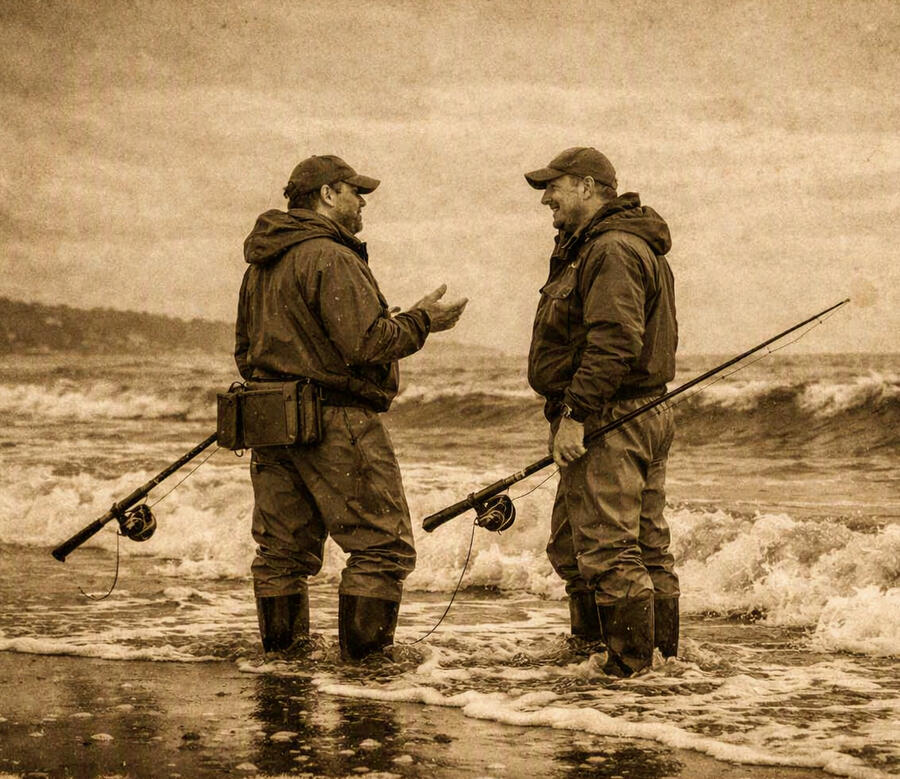
How River Casters and Surf Spey Casters Can Work in TandemTwo Disciplines, One Mechanical FoundationPurpose
River Spey and Surf Spey are distinct disciplines built for different environments. But they share the same biomechanical laws, rod-tip geometry requirements, and the same sequencing principles.This article explains how casters from both environments can work together, learn from each other, and strengthen the unified mechanical foundation of two-hand casting.1. River Casters Bring Geometry DisciplineRiver casters excel at:
• straight line rod tip path
• sustained anchor control
• compact D loop formation
• plane discipline
• tension management in stable waterThese skills transfer directly into Surf Spey.Surf casters benefit from river casters because river mechanics:
• sharpen plane awareness
• refine anchor placement
• improve sweep geometry
• reinforce straight line tip tracking
• strengthen stroke disciplineRiver casters provide the geometric backbone of two hand casting.2. Surf Spey Casters Bring Hydrodynamic Awareness
Surf Spey casters excel at:
• timing windows
• tension preservation under instability
• apex control without water support
• load stabilization in collapsing mediums
• late rotation under compressed timingThese skills transfer directly into river Spey.River casters benefit from Surf Spey because surf mechanics:
• improve tension discipline
• strengthen apex awareness
• refine load management
• sharpen rotation timing
• eliminate slack eventsSurf casters provide the environmental intelligence of two-hand casting.3. Both Disciplines Share the Same Biomechanical LawsRegardless of environment, both disciplines rely on:
• translation → late rotation
• straight line rod tip path
• crisp deceleration stop
• tension continuity
• apex geometry
• linear acceleration corridorThese laws do not change between river and surf.When river casters and surf casters work together, they reinforce the same universal mechanics from two different angles.4. River Casters Improve Surf Spey FundamentalsRiver casters help Surf Spey casters with:
• anchor stability
• sweep discipline
• loop geometry
• rod tip tracking
• stroke consistencySurf Spey casters often struggle with:
• over-sweeping
• anchor collapse
• inconsistent planes
• premature rotation
• tension breaksRiver casters correct these issues quickly because they come from a discipline built on precision geometry.5. Surf Spey Casters Improve River Spey Timing and Load AwarenessSurf casters help river casters with:
• apex height
• apex depth
• tension direction
• load preservation
• late rotation timingRiver casters often struggle with:
• low apex
• early rotation
• soft stops
• slack events
• overreliance on water supportSurf casters correct these issues because they come from a discipline built on unstable load management.6. Together, They Create a Complete CasterA caster trained in both disciplines becomes:
• geometrically disciplined (river)
• tension aware (surf)
• apex conscious (surf)
• plane precise (river)
• rotation timed (surf)
• sweep controlled (river)
• load stable (surf)This combination produces the strongest possible two-hand caster.
River casters provide structure. Surf casters provide stability under chaos.Together, they create mechanical completeness.7. The Disciplines Are Complementary, Not CompetitiveRiver Spey solves river problems. Surf Spey solves surf problems.
Neither replaces the other. Neither contradicts the other.They operate in different mediums but share the same mechanical laws.Working in tandem:
• river casters gain environmental adaptability
• surf casters gain geometric refinement
• both gain deeper biomechanical understanding
• both reinforce the same universal principlesThis is how the disciplines strengthen each other.Final Statement
River casters and Surf Spey casters can work in tandem because they share the same biomechanical laws but operate in different environments. River casters bring geometric discipline; Surf Spey casters bring tension and timing discipline. Together, they create a complete caster capable of precision in stable water and stability in dynamic water. The disciplines are not competing interpretations - they are complementary expressions of the same mechanical truths.